
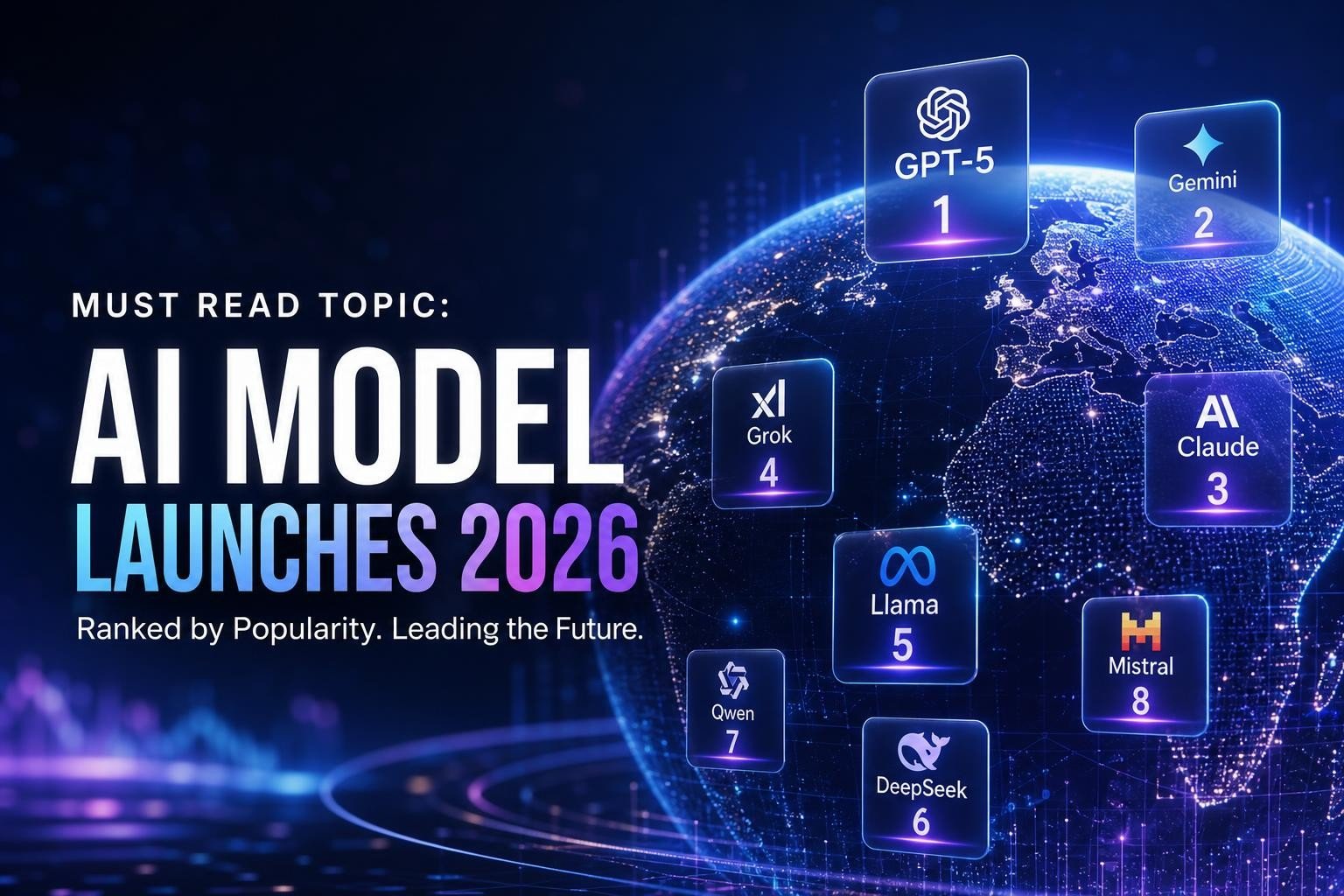
Editorial note: The request refers to “2026-207,” which is interpreted here as 2026-27. Because AI release calendars and adoption signals change quickly, this ranking should be treated as an editorial popularity assessment rather than a definitive real-time market index. Launch dates and availability should be rechecked before publication.
The AI model market has moved beyond a simple race for benchmark leadership. Developers, enterprises and governments are now weighing reliability, operating cost, multimodal capability, deployment options and access to computing infrastructure. Popularity therefore reflects a model’s visibility, developer interest and commercial reach, not one technical score.
How the ranking was assessed
The list considers broad public awareness, ecosystem strength, enterprise relevance, developer adoption and the strategic importance of each release. The ranking does not claim that one model is best for every task. Closed models often lead on ease of use and integrated products, while open-weight systems can be more attractive to organizations that require control over deployment and data.
1. OpenAI GPT-5
GPT-5 sits at the top of this editorial ranking because OpenAI’s model releases continue to attract unusually broad attention from consumers, software developers and corporate buyers. Its strongest commercial advantage is likely to be integration across products, APIs and workplace tools.
For businesses, the important question is less whether GPT-5 leads every benchmark than whether it improves reliability, tool use and the cost of completing routine knowledge work. Organizations considering adoption should examine usage limits, data controls, latency and the difference between public access and enterprise plans.
2. Google Gemini
Google’s Gemini family remains one of the most visible competitors because it connects model development with Search, Workspace, Android and Google Cloud. That distribution gives Gemini a route into existing business workflows that does not depend solely on standalone chatbot traffic.
Its popularity is supported by multimodal functionality and the company’s reach across consumer and enterprise software. Buyers should still evaluate the specific Gemini model, regional availability and pricing rather than treating the family name as a single product.
Google DeepMind’s Gemini overview
3. Anthropic Claude
Claude has built a strong reputation among professional users who value long-form analysis, writing quality and cautious responses. Anthropic’s enterprise positioning has also made Claude an important option for companies exploring internal knowledge systems, software development and research workflows.
Popularity will depend on how effectively newer releases handle long context, agentic tasks and predictable output under heavy usage. Organizations should compare performance on their own documents and processes instead of relying on general reputation.
4. xAI Grok
Grok has gained visibility through its relationship with the X platform and its positioning as a fast-moving alternative in the consumer AI market. Its appeal is strongest among users interested in real-time information, social-platform integration and a less formal conversational style.
For business buyers, the key tests are source quality, governance, privacy and consistency. High visibility can accelerate adoption, but it does not remove the need for procurement and risk review.
5. Meta Llama
Meta’s Llama family remains highly influential because open-weight access changes how companies and developers experiment with AI. Organizations can adapt, fine-tune or deploy compatible versions in ways that may be difficult with fully hosted services.
Llama’s popularity is closely tied to its ecosystem. Cloud providers, model hosts and independent developers can build services around the models, creating a wider distribution network. The trade-off is that deployment, security and performance optimization often require more technical work.
6. DeepSeek
DeepSeek has become an important name in discussions about model efficiency, open access and the global distribution of AI capability. Its rise has focused attention on whether high-quality reasoning and language performance can be delivered at lower operating costs.
Companies assessing DeepSeek should consider hosting arrangements, data governance, model licensing and the reliability of third-party access points. The commercial opportunity is significant, but deployment decisions require the same diligence applied to any external model.
7. Alibaba Qwen
Qwen is one of the most prominent model families from China and has attracted attention among developers seeking multilingual performance, open access and a broad range of model sizes. Its importance extends beyond one product because it reflects the increasingly competitive nature of the global AI supply chain.
International users should review licensing terms, hosting options, language performance and applicable data regulations. Qwen’s popularity is likely to remain strongest where developers value flexibility and regional ecosystem access.
Qwen model research and releases
8. OpenAI o-series reasoning models
OpenAI’s reasoning-focused models have helped establish a separate product category within generative AI. Their value lies in tasks that require more deliberate problem-solving, planning or multi-step analysis rather than rapid conversational responses alone.
These models can be attractive for technical, analytical and coding workflows, although higher reasoning effort may affect speed and cost. Businesses should test whether the additional capability produces measurable gains in their own operations.
9. Google Gemma
Gemma gives Google a smaller and more developer-oriented model family alongside its flagship Gemini products. Its relevance comes from the demand for models that can run closer to the user, support experimentation and reduce dependence on a large hosted system.
Smaller models can be useful for classification, summarization, local assistants and specialized applications. Their business value depends on the quality of the implementation, available hardware and the level of customization required.
10. Mistral AI models
Mistral remains a notable European contender because it combines commercial APIs with a strong focus on efficient models and deployment choice. Its presence gives European enterprises and public-sector buyers another major supplier to consider as they seek more diversified AI infrastructure.
Mistral’s position will be shaped by model quality, enterprise support, regulatory alignment and the ability to serve customers that want alternatives to the largest US technology companies.
What the popularity ranking means for business
Popularity can lower the friction of adoption because widely used models usually have larger developer communities, more integration partners and greater availability across cloud platforms. It can also create concentration risk. When many companies rely on the same supplier, changes to pricing, access rules or safety policies can affect entire workflows.
Executives should therefore separate brand recognition from operational fit. A model with less public attention may be the better choice for a narrow task, a regulated environment or an organization that needs local deployment. Procurement teams should compare total cost, security controls, service continuity, auditability and exit options.
For additional coverage of technology strategy and digital transformation, visit the Innovation and Technology section.
The ranking will keep changing
The AI market is moving too quickly for a popularity table to remain fixed for long. New releases, pricing changes, open-weight alternatives and distribution agreements can quickly alter the competitive picture. The most durable winners will be the models that combine technical capability with dependable access, clear governance and a business case customers can defend.