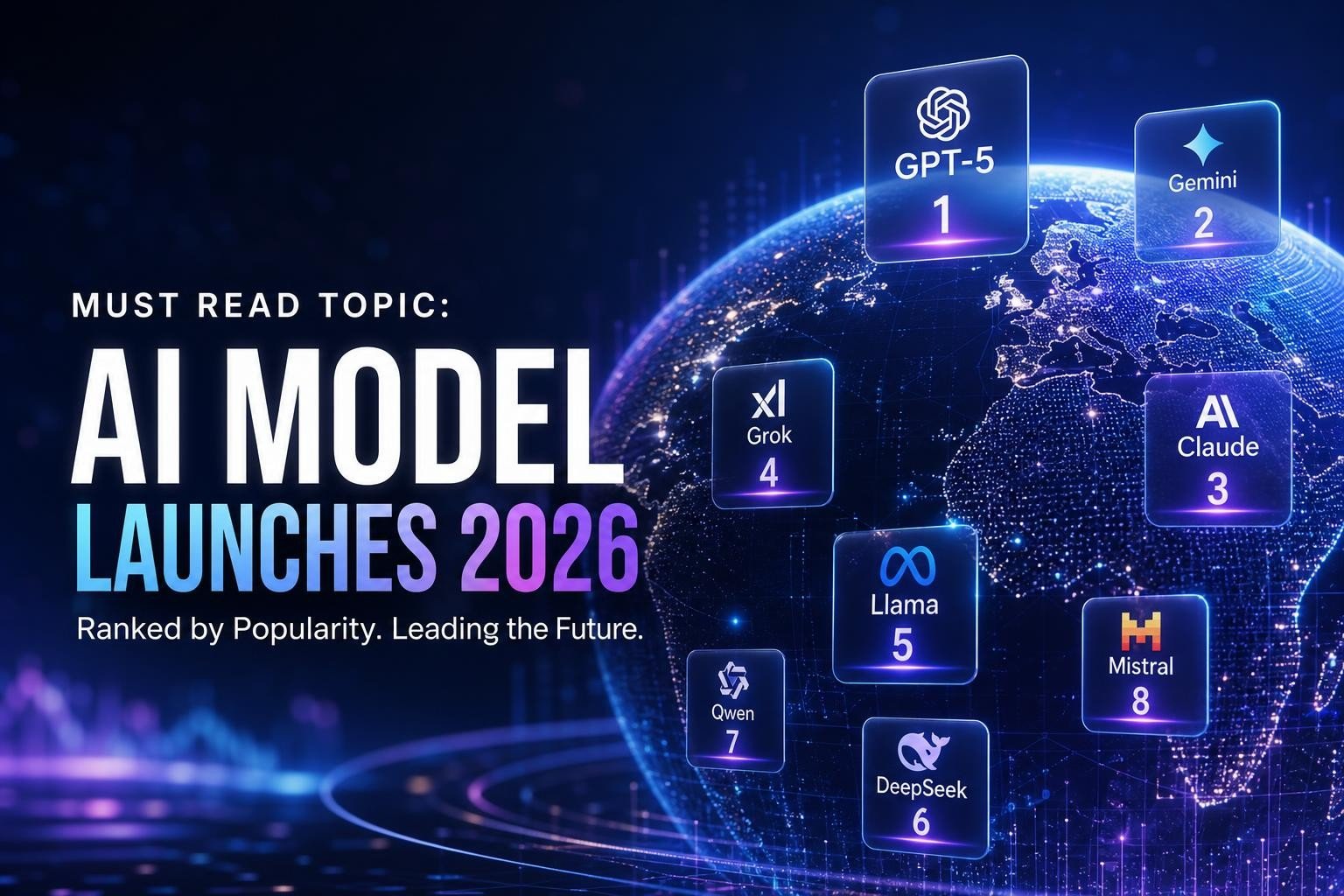
Editor’s note: A definitive ranking of the latest AI model launches in 2026 and 2027 cannot yet be verified from publicly confirmed information. The list below is therefore a forward-looking tracker of the model families and developers most likely to shape the next phase of competition. It distinguishes confirmed product directions from speculation and avoids treating unannounced systems as finished products.
The commercial AI market is moving beyond headline model size. Buyers are increasingly comparing reliability, tool use, deployment options, data controls, operating cost and performance on specialised work. The next generation will be judged less by a single benchmark and more by how well it fits into business processes.
What will separate the next generation of AI models?
Several changes are likely to define model launches during this period. Longer-running agents may handle multi-step assignments with less supervision. Models may also become more useful across text, image, audio, video and software environments, while smaller versions could make local and private deployment more practical.
Those developments remain areas to monitor rather than guaranteed outcomes. A model’s marketing claims will need to be tested against independent evaluations, real-world error rates and the total cost of operating it.
10 AI model launches and model families to watch
- OpenAI’s next-generation models
OpenAI is likely to remain one of the market’s most closely watched developers. The important comparison with earlier systems will be whether future models can complete longer workflows, use external tools more reliably and maintain context across complex tasks. Enterprise buyers will also examine access controls, auditability and the balance between high capability and operating cost. Any model name or launch date should be treated as unconfirmed until OpenAI publishes it through an official channel. - Anthropic’s next Claude generation
Anthropic’s future releases will be assessed against the company’s established emphasis on dependable business use and safety controls. The key question is whether the next generation can improve reasoning and coding without increasing the review burden for users. Customers will also compare context handling, agent permissions and performance on long documents with earlier Claude systems. See Anthropic’s official news and research updates for confirmed announcements. - Google Gemini’s next major release
Google has an unusual advantage in the AI market because its models can connect with a broad ecosystem of search, cloud, productivity and mobile products. The meaningful difference in a future Gemini release will be how tightly those capabilities work together while preserving user controls and factual reliability. Businesses will watch integration with Google Cloud, Workspace and developer tools, not just standalone chatbot performance. Confirmed updates are published through Google’s AI blog. - Meta’s next Llama generation
Meta’s open-model strategy has helped make downloadable and adaptable systems central to the AI market. A future Llama release could be judged by the quality of its openly available weights, licensing terms, hardware efficiency and suitability for enterprise fine-tuning. The comparison with previous Llama models will depend on how much capability developers can access without relying on a closed application programming interface. - xAI’s next Grok model
xAI’s future model releases will be watched for their relationship with real-time information, conversational use and integration across the company’s digital ecosystem. The main business comparison will be the reliability of current-information retrieval, the transparency of sources and the controls available to organisations. Buyers should separate live product features from claims made before formal release or independent testing. - Mistral AI’s next commercial and open models
Mistral AI has become an important European competitor across open and commercial AI. Its next releases will be evaluated on whether they provide a strong capability-to-cost ratio, efficient deployment and practical multilingual performance. The difference from previous models may matter most for companies seeking greater control over hosting, customisation and regional data governance. Mistral’s official announcements are the appropriate source for launch confirmation. - DeepSeek’s next reasoning-focused systems
DeepSeek has increased attention on the possibility of delivering advanced performance at comparatively low infrastructure cost. Future releases will be judged on reproducibility, licensing, availability, security review and performance outside the benchmarks used to promote them. For global companies, regulatory requirements and dependable access may be as important as raw model capability. - Alibaba’s next Qwen models
Qwen’s future development will be particularly relevant to organisations operating across Asian markets and to developers interested in multilingual and open-model options. The comparison with earlier Qwen systems will include language coverage, coding performance, model sizes and commercial terms. Buyers should verify whether a release is available for commercial use and where its infrastructure can be hosted. - Amazon Nova’s next model family
Amazon’s model strategy is closely connected to cloud infrastructure and enterprise procurement. Future Nova releases will be measured by their performance within managed cloud services, integration with business data and the ability to support different levels of model cost and capability. The central difference from earlier systems may be operational rather than purely technical: how easily companies can connect models to governed workflows. - Cohere’s next enterprise AI models
Cohere is positioned around business applications, retrieval and controlled deployment. A future release will be assessed by how accurately it works with private company information, how well it supports multilingual operations and whether it can be deployed under strict data policies. For enterprises, lower exposure of sensitive information and predictable administration may outweigh small differences in general chatbot scores.
How businesses should compare new models
A model launch should not be treated as a purchasing decision by itself. Companies should test representative tasks from their own operations, including difficult cases and failure scenarios. Useful measures include factual accuracy, citation quality, latency, cost per completed task, tool-use reliability and the amount of human correction required.
Governance also needs to be part of the evaluation. Buyers should review data retention, training policies, regional availability, access permissions, incident reporting and the provider’s approach to model updates. A model that performs well in a public demonstration may be unsuitable for a regulated workflow if its behaviour changes without adequate notice.
Smaller models deserve particular attention. They may offer lower latency, reduced infrastructure costs and more deployment flexibility, especially for routine classification, summarisation and internal search. Larger systems will remain important for demanding reasoning and multimodal work, but the market is likely to become more segmented rather than dominated by a single winner.
The strategic question for 2026 and 2027
The most important shift may be from choosing the strongest general-purpose model to designing a portfolio of models. A company could use a smaller system for high-volume tasks, a specialist model for coding or retrieval, and a larger model for complex decisions that require human review.
That makes transparency around pricing, performance changes and deployment conditions strategically important. Executives should follow official release documentation, independent evaluations and their own controlled tests before committing critical work to any new system.
For more coverage of AI infrastructure, software and emerging technology, visit our Innovation and Technology section.
Bottom line
There is not yet a verified basis for calling any unannounced 2026 or 2027 system the latest or best AI model. The meaningful differences will emerge through confirmed releases and practical testing: stronger reasoning, more reliable agents, better multimodal interaction, lower deployment costs and tighter enterprise controls. Businesses that prepare evaluation criteria now will be better positioned when the next wave of models arrives.