
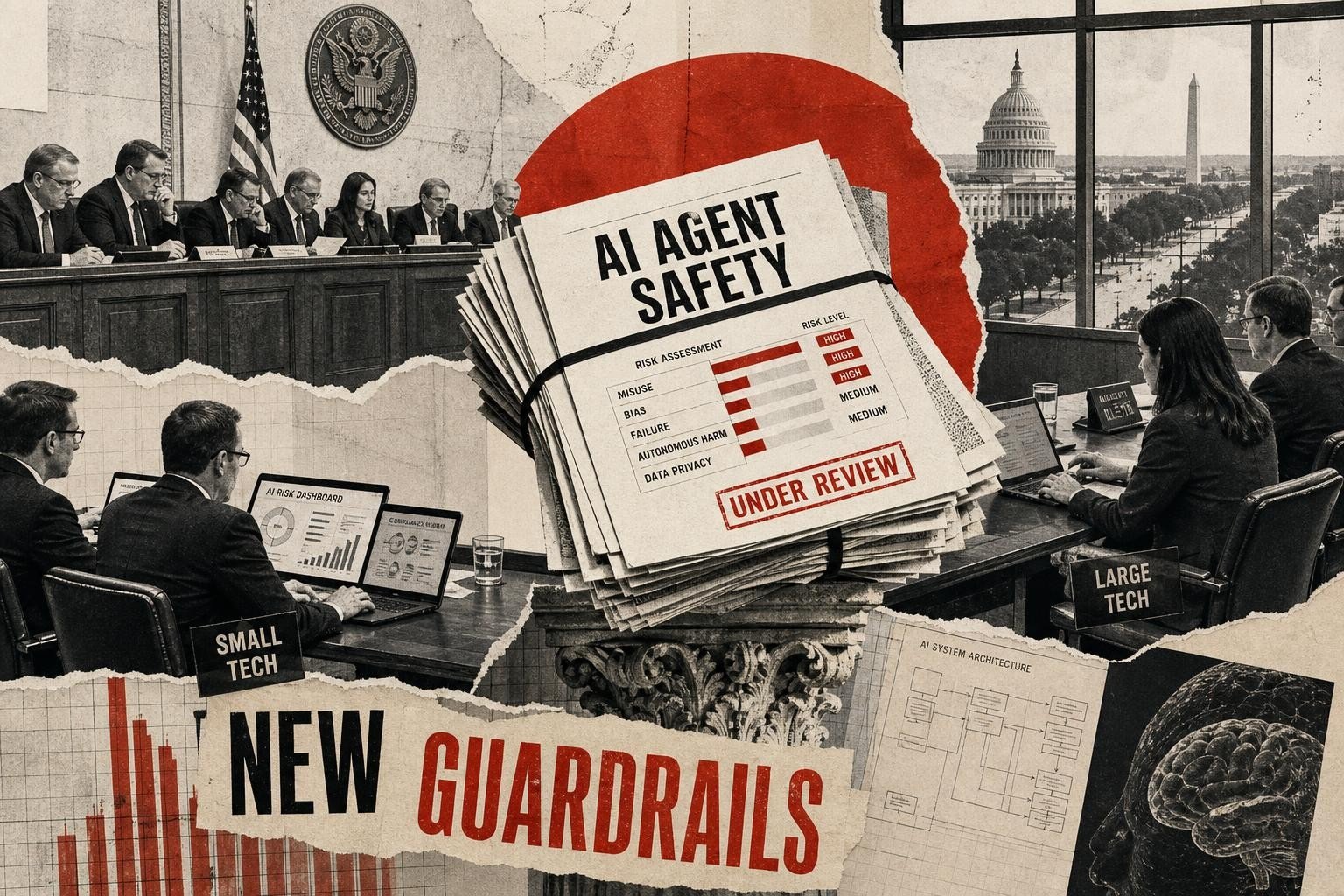
Warnings about autonomous AI agents have moved rapidly from research circles into boardrooms and government offices. Companies developing foundation models now discuss systems that can browse the web, write and execute code, use business software and complete multistep tasks with limited supervision. Some executives and researchers have also raised concerns about misuse, loss of control and the prospect of increasingly capable systems.
That concern may be sincere. It may also serve a strategic purpose. Strict regulation can create advantages for the largest AI companies by raising compliance costs, increasing the value of proprietary safety infrastructure and making it harder for smaller rivals to compete. The important question is not whether AI labs are coordinating a false narrative. Public evidence is not sufficient to establish that. The more credible question is whether the industry’s incentives are shaping which risks receive attention and which regulatory solutions appear reasonable.
Fear can become a powerful regulatory asset
Large AI companies have a complicated relationship with regulation. Clear rules can reduce uncertainty, reassure enterprise customers and make governments more comfortable with widespread adoption. At the same time, complex obligations can favor companies with large legal, security and compliance departments.
Requirements involving model evaluations, incident reporting, cybersecurity, data governance, documentation and post-deployment monitoring may be manageable for a multinational technology company. A smaller developer may face the same obligations without comparable funding or technical staff. The result could be a market in which regulation formally applies to everyone but operates as a much heavier burden for new entrants.
This is a familiar pattern in heavily regulated industries. Rules designed to protect the public can also strengthen incumbents when compliance is expensive, ambiguous or dependent on infrastructure that only a few companies can afford. That possibility deserves scrutiny in AI policy, particularly when proposed rules address broad categories such as “frontier” or “high-risk” systems rather than specific applications and measurable harms.
The agent debate contains real risks
It would be a mistake to dismiss every warning about AI agents as lobbying. Systems that can take actions rather than merely generate text create practical risks. An agent with access to email, financial tools, internal databases or software deployment systems could make errors at a speed and scale that are difficult to contain. Poorly designed permissions, prompt injection, insecure integrations and weak human oversight are legitimate areas of concern.
These risks do not require predictions about machines escaping human control. They can arise from ordinary business failures: an agent sends confidential information to the wrong recipient, approves an unsuitable transaction or follows manipulated instructions from an external webpage. Regulators and companies have reason to address those scenarios.
The challenge is to distinguish evidence-based risk management from speculative claims that encourage broad restrictions without showing how the proposed rules would reduce harm. A policy aimed at hypothetical future capabilities should not automatically impose the same burden on a small software company using an existing model for a narrow administrative task.
Where the narrative may become self-serving
AI labs occupy an unusual position in the policy debate. They build the systems being discussed, publish much of the technical research, advise governments and often supply the tools that businesses want to deploy. Their warnings therefore carry expertise, but also commercial interests.
Companies may benefit when public discussion focuses on model-level danger rather than deployment-level accountability. A framework centered on the largest models can place responsibility on a relatively small group of developers, while a framework focused on use cases would distribute obligations across vendors, integrators and customers. Neither approach is automatically correct. The choice determines who pays, who is liable and who controls access to the market.
There is also a communications incentive. Dramatic claims about future AI capabilities attract attention, investment and political engagement. They can make a company appear indispensable to the safety conversation. That does not prove the claims are false, but it does mean they should be examined alongside independent testing, reproducible evidence and clear definitions of the harm being predicted.
What proportionate regulation would look like
A workable framework should be based on the capability and context of a system, not simply the identity of its developer. Rules could distinguish between a general-purpose model, an agent with permission to act in sensitive systems and a narrow application with limited access and reversible effects.
Regulators should also consider the scale of deployment, the sensitivity of the data involved, the possibility of human review and the consequences of failure. A system that drafts marketing copy does not present the same operational risk as one that changes production code or makes decisions affecting employment, credit or healthcare.
Compliance obligations should be graduated where possible. Standardized documentation, shared testing tools, regulatory sandboxes and clear technical guidance could help smaller companies meet requirements without replicating the cost structure of a major laboratory. Policymakers should also review whether rules create unnecessary duplication across jurisdictions. Global developers already face a patchwork of obligations, and smaller firms are less able to absorb that complexity.
The European Union’s AI regulatory framework illustrates the direction of travel, with obligations varying according to the risk associated with an AI system. The NIST AI Risk Management Framework offers another reference point for managing risks through governance, measurement and monitoring rather than relying only on broad prohibitions.
How to test the industry’s claims
Governments do not need to accept or reject the AI labs’ narrative as a package. They can ask more precise questions. What evidence supports a claimed risk? Which systems are affected? Can the risk be measured independently? Would the proposed rule address the source of the harm, or merely increase the cost of operating a model? What exemptions or support would prevent compliance from becoming a barrier to entry?
Policymakers should seek input from smaller developers, enterprise users, civil society groups, security researchers and affected workers, not only from companies that build the most powerful models. They should publish impact assessments that examine market concentration as well as safety outcomes.
For business leaders, the practical lesson is equally clear. Regulation is coming, but companies should not wait for a final rule before mapping how AI tools access data, make decisions and affect customers. A useful internal approach is to document permissions, assign accountable owners, test failure scenarios and keep high-impact actions subject to human approval. Readers can also explore our Innovation and Technology coverage and related analysis in Global Affairs and Policy.
AI agents deserve serious oversight. So do the incentives of the companies describing their dangers. The public interest is best served when regulation is grounded in demonstrated risks, scaled to actual exposure and designed to preserve responsible competition. Fear may help put an issue on the political agenda. It should not, by itself, determine who is allowed to participate in the market.